

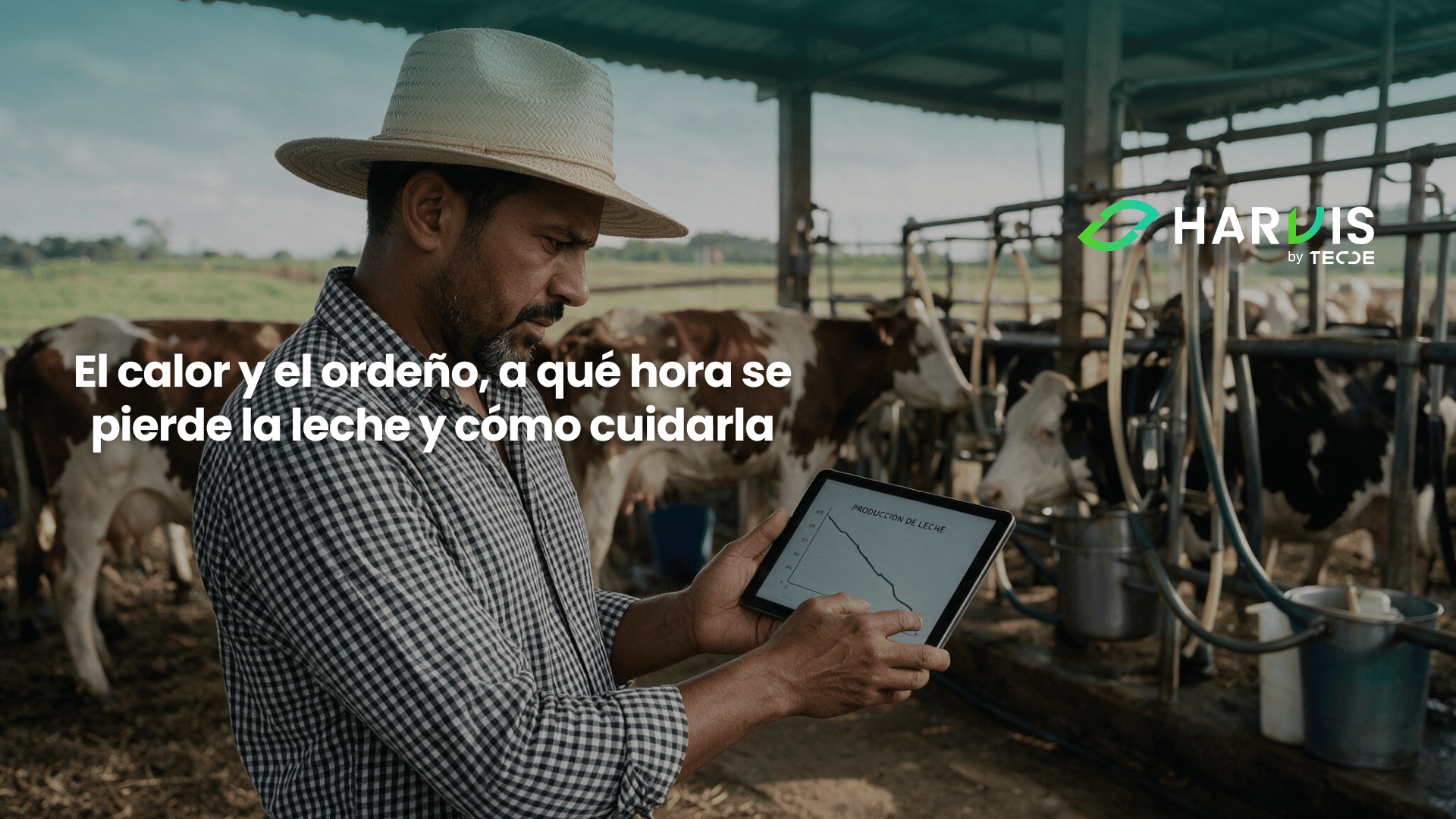
It is the third straight afternoon of strong sun, and the milker notes fewer liters than last week. The pasture is the same, the concentrate did not change, and the cows are not sick. What changed was the day before yesterday: a clear day, with no breeze and high humidity, and the milk lost that day is only now showing up in the tank. In a dairy, the biggest drop comes 36 to 48 hours after the hot day, so anyone who looks only at today’s milking is searching for the cause in the wrong place.
There is more than a 95% chance that El Niño will remain active until the first quarter of 2027, and a 63% chance that it will become very strong between November and January, with temperatures above normal in much of the country. For a dairy, that means more days of reduced production in a row, հենց when pasture starts to become scarce.
In this blog we are going to talk about why a dairy cow suffers heat more than other animals, how to measure the heat that really harms her, what time of day it hits her and why the night determines recovery, and what actually works in the pasture and in the barn to sustain liters.
The heat the cow cannot get rid of
A cow that produces milk is, inside, a small boiler. To produce each liter, she digests a lot of grass and a lot of concentrate, and that digestion, which happens in the rumen through fermentation, releases heat all day long. The more milk she gives, the more heat she generates, and that is why the high-producing cow is the first to feel a hot day. That heat leaves in only a few ways: sweating, breathing faster, and, when that is not enough, panting with her mouth open.
The problem is that those outlets cost energy. A cow under heat stress spends between 7% and 25% more energy just to maintain herself, energy that could produce between 1 and 3.4 kilos of milk per day. In addition, the overheated cow stops eating during the sunny hours.
For every point the heat index rises, which I explain in the next section, a dairy cow eats about half a kilo less dry matter per day. But eating less does not explain the whole loss. In a trial with Holstein cows, giving cows in cool weather the same reduced ration eaten by heat-stressed cows explained only between 40% and 50% of the milk lost; the rest is due to what heat does to the body from the inside. That is why increasing concentrate on hot days does not bring the milk back.
Humidity makes everything worse. Sweat cools when it evaporates, and in air loaded with water it evaporates less, so the same 28-degree day feels much heavier with humidity and no breeze. Crossbred animals with Zebu or Creole genetics tolerate that heavy air better, and later I will return to why that does not make them immune.
Temperature and humidity together: the number that warns before the tank does
Because the heat a cow suffers depends on temperature and humidity at the same time, one number is used to combine both: the temperature-humidity index. There is no need to calculate it by hand: with a thermometer that also shows humidity and a printed table, anyone on the farm can read it. The scale is read like this: below 68 the cow shows no stress; between 68 and 72 the stress is mild; between 72 and 78 it is moderate, and from 78 upward it is severe.
In practice, a dairy cow starts losing production when the index goes above 68, and in the tropics that number is exceeded many days of the year, because in warm areas the index stays above 69 almost all the time. That is the first lesson: in hot country, heat stress is not a rare summer event, it is the normal condition on top of which the worst days fall.
That threshold changes with breed. In more than twenty thousand Holstein crossbred cows in tropical weather, milk began to drop when the index reached 76, well above the threshold for pure Holsteins. The crossbred cow tolerates more, but not everything.
That 76 is reached at about 26 degrees and humidity close to 65%, a common afternoon in hot or temperate country. In other words, on the day the yard thermometer shows that, even the crossbred cow is already paying the price.
This number also gives advance warning. Since milk drops one or two days after the hot day, and in freshly calved cows it responds to the index from two days earlier, a high index recorded today tells you what will happen in Thursday’s milking.
What time heat hits, and why the cool night is what saves her
The heat of a day does not hit evenly. In the morning the cow starts with the body cooled by the night and gradually accumulates heat as the sun rises. The worst moment comes in the afternoon, when the index is at its highest and the cow’s body has spent hours unable to get rid of everything it receives: in a controlled-heat trial, cows reached 40.6 degrees of internal temperature in the afternoons, almost two degrees above normal for a healthy cow. A person with that difference would have a fever.
That is why grazing at two in the afternoon is the most expensive in milk. A cow in full sun at that hour is not eating: she is looking for shade or standing still, and what she stops eating at midday is not fully recovered later. Heat-stressed cows eat more at night, when the temperature drops, so the feed they do not want at noon they do want at nine at night.
The night is also when the cow recovers. If the temperature drops below about 21 degrees during the night, the animal has room to release the day’s heat and wake up ready for another day. The big damage appears when the night does not cool down: the cow starts the next day carrying the heat from the previous one, and each day adds to the next. In El Niño years, with nights warmer than normal, it is that chain of sleepless nights that knocks down the liters, more than a single hot midday.
This changes what is worth measuring: midday temperature tells you how much the cow suffered, and early-morning temperature tells you whether she recovered. As we already covered in our blog Smart livestock farming: How technology transforms 21st-century livestock production, which you can read here, technology in dairying works when it turns what happens in the pasture into data that can be checked; in the case of heat, that data is the temperature and humidity of each hour, including the early morning, placed alongside the liters from each milking.
Knowing which pasture and which hour are costing milk in your herd
Do you know how many liters you lost last week because of heat, and in which pasture the cows were on the days when the tank dropped the most? In most dairies, temperature is not recorded, liters are only checked by the tank total, and nobody crosses the two, so heat is felt but cannot be managed. Harvis helps you record from your phone the temperature and humidity of each day, the liters per milking, and the pasture where each group was, and shows you when a hot day turned into lost milk two days later and in which pasture it happened. Write to us and we will set it up using the pastures and cow groups you already have.

Shade, water, and schedules: what works in the pasture and what works in the barn
Shade is the first defense, and in the pasture the cheapest shade is from trees. In a beef cattle system with trees inside the grassland, the canopy blocked 62.4% of solar radiation, and the animals grazing there showed fewer signs of stress in the blood than those in open pasture. Where there are no trees, a shade cloth that blocks between 70% and 80% of the sun does the same job in the corral or waiting area.
Shade shows up in the milking, especially in freshly calved cows. In a trial with high-producing cows on pasture, the heat from two days earlier reduced milk in both shaded and unshaded cows, but the drop was smaller in the shaded ones. Shade does not erase the effect of heat; it reduces it, and in a cow at the start of lactation, when she produces the most, reducing it matters a lot.
Water is the second defense, and the most forgotten. A cow under heat stress drinks more water: intake rose 29% when temperature went from about 18 to about 30 degrees. And she drinks at specific times, because between 30% and 60% of the day’s water is consumed shortly after milking. That is why a large trough at the exit from milking works better than two at the back of the pasture.
In grazing, the cow should not have to walk more than about 180 meters to water, and the recommendation is one trough for every 15 to 20 cows, with at least two sources per group, so the shyer cows do not go without drinking. If water is far away, the cow walks in the sun to drink or, worse, drinks less than she needs.
Scheduling is the third defense, and it costs nothing. If cows eat more at night, it makes sense to open the new pasture at the end of the afternoon and to offer concentrate and cut forage during the cool hours. Moving afternoon grazing to the shadiest pasture, and leaving the pasture open for dawn and dusk, uses the same grass without asking the cow to eat at the worst time. And moving cattle at midday, walking in the sun, adds heat right before milking.
Then there is breed. Crossbred cows tolerate more because their thresholds are higher. There is even a type of short, smooth hair, inherited from a tropical-origin breed, that allows Holstein cows that carry it to sweat more, keep body temperature lower, and lose less milk in summer. And in a shade trial with Gyr cows, a dairy Zebu breed, and Girolando, their Holstein cross, the Girolando produced about 16 kilos per day versus almost 10 for the Gyr. But breed does not replace management: a crossbred cow without shade, without nearby water, and grazing at midday also loses milk, only she starts losing it a few degrees later.
What one trial does not tell you about your pasture
First, heat thresholds depend on breed and production level. 68 is the reference for high-producing Holstein cows, and 76 came from crossbred cows in tropical weather. A herd of Zebu crosses or Creole breeds does not necessarily start losing milk at the same number, and in three Colombian Creole breeds measured under the same conditions, no differences appeared among them. The threshold for your herd only comes from your own records.
Second, the index is calculated with air in the shade, and the cow in the pasture receives direct sun and varying wind. In Creole cattle, an index that also takes wind and solar radiation into account described stress better than the temperature-humidity index alone. The thermometer number is a reference, not the exact measure of what each cow feels.
Third, shade does not work the same everywhere. In a trial with Gyr and Girolando cows, tree shade kept the udder skin about 2 degrees cooler, but the cows’ internal temperature did not drop, and the authors attribute that to less airflow under the trees. Dense shade in a corner with no breeze may provide less relief than expected, and that is checked by looking at the cow, not just the tree.
Fourth, the figures in this blog come from trials in Thailand, Brazil, Sweden, and the United States, with breeds and systems that are not the same as your farm’s. The 36 to 48 hour delay or the 21-degree night are references to start with, not numbers to copy. What does travel is the logic: measure the heat of each day, including the early morning, and place it next to the liters from two days later.
Ten cows, a wall thermometer, and the liters from each milking
Choose ten producing cows from the same group, preferably several at the start of lactation, since they feel heat the most. For four weeks, record the liters from each cow at each milking, not the tank total. Ten cows are enough to see the pattern without making the record a burden.
Hang a wall thermometer that also shows humidity in the corral or waiting area, in the shade and away from the zinc roof. Read it three times a day, at six in the morning, two in the afternoon, and nine at night, and write down the two numbers. With a printed temperature-humidity index table, you will know which days went above 68. Pay special attention to the early-morning reading: if the night did not drop below about 21 degrees, that day counts double.
At the end of each week, compare each cow’s liters with the index from two days earlier, because the big drop comes 36 to 48 hours after the hot day. If the ten cows drop together after high-index days, you have found your herd’s threshold. Also note which pasture they were in those days and whether they had shade and water nearby, and check whether the trough at the milking exit is actually full at that time, because between 30% and 60% of the day’s water is drunk there.
In the third and fourth weeks, try one change only, for example moving afternoon grazing to the pasture with more trees or offering fresh forage at dusk, so the record tells you what worked. After four weeks you will have the heat number at which your herd starts losing milk, the time of day that costs you the most, and a management change tested on your own farm.
Milk lost at midday is protected from the night before
Heat does not take milk from a cow in one blow or at the moment it is felt. It takes it in three steps: it makes her spend energy cooling down, keeps her away from the feed bunk during sunny hours, and leaves her unable to recover when the night does not cool off. That is why the loss appears one or two days later and gets confused with anything else. In a strong El Niño year, the dairy that understands that order acts before the tank drops.
What you can do starting Monday fits into five decisions. Hang a thermometer with humidity in the corral and record early morning, afternoon, and night, because the early morning is what tells you whether the cow recovered. Put the largest trough at the milking exit and make sure it has water when the cows come out. Move grazing out of the sunny hours to the shadiest pasture and leave the pasture open for dusk. Offer forage and concentrate during the cool hours, when the cow actually wants to eat. And compare each cow’s liters against the heat from two days earlier, not today’s. The producer who finishes the dry season with that record will know how much heat the herd can handle and which change brought liters back; the one who only looks at the tank will keep blaming the grass, the cow, or the concentrate for what was really a midday without shade and a night without relief.
Do you want to know which hot days cost you milk, in which pasture and at what time, so you can change management before the tank drops? Write to us and we will show you how Harvis brings together the corral thermometer and the liters from each milking in a single record.
References consulted
- Amaral-Phillips, D. M. (n.d.). Dairy feeding and management considerations during heat stress. University of Kentucky Cooperative Extension. https://afs.mgcafe.uky.edu/files/dairy%5Ffeeding%5Fand%5Fmanagement%5Fconsiderations%5Fduring%5Fheat%5Fstress.pdf
- IDEAM (2026). IDEAM indicates that El Niño-type conditions are already present. Institute of Hydrology, Meteorology and Environmental Studies. https://www.ideam.gov.co/sala-de-prensa/noticia/ideam-indica-que-las-condiciones-tipo-el-nino-ya-se-encuentran-presentes
- Chang-Fung-Martel, J., Harrison, M. T., Brown, J. N., Rawnsley, R., Smith, A. P. and Meinke, H. (2021). Negative relationship between dry matter intake and the temperature-humidity index with increasing heat stress in cattle, a global meta-analysis. International Journal of Biometeorology, 65(12), 2099–2109. https://pmc.ncbi.nlm.nih.gov/articles/PMC8566424
- O'Brien, M. D., Wheelock, J. B., Baumgard, L. H., Rhoads, M. L., Duff, G. C., Bilby, T. R., Collier, R. J. and Rhoads, R. P. (2008). The effects of heat stress on production, metabolism and energetics of lactating and growing cattle. Florida Ruminant Nutrition Symposium, University of Florida IFAS. https://animal.ifas.ufl.edu/apps/dairymedia/rns/2008/Baumgard.pdf
- Zhang, Q., Yang, L., Li, Y., Gu, P., Si, R., Zhu, L. and Zhang, W. (2025). Heat stress affects dairy cow performance via oxidative stress, hypothalamic–pituitary–adrenal axis, gut microbiota, and multi-dimensional mitigation. Frontiers in Veterinary Science, 12. https://doi.org/10.3389/fvets.2025.1686241
- Boonkum, W., Teawyoneyong, W., Chankitisakul, V., Duangjinda, M. and Buaban, S. (2024). Impact of heat stress on milk yield, milk fat-to-protein ratio, and conception rate in Thai–Holstein dairy cattle, a phenotypic and genetic perspective. Animals, 14(20), 3026. https://doi.org/10.3390/ani14203026
- Nielsen, P. P. and Wredle, E. (2023). How does the provision of shade during grazing affect heat stress experienced by dairy cows in Sweden? Animals, 13(24), 3823. https://doi.org/10.3390/ani13243823
- Igono, M. O., Bjotvedt, G. and Sanford-Crane, H. T. (1992). Environmental profile and critical temperature effects on milk production of Holstein cows in desert climate. International Journal of Biometeorology, 36, 77–87. https://link.springer.com/doi/10.1007/BF01208917
- Lemes, A. P., Garcia, A. R., Pezzopane, J. R. M., Brandão, F. Z., Watanabe, Y. F., Cooke, R. F., Sponchiado, M., de Paz, C. C. P., Camplesi, A. C., Binelli, M. and Gimenes, L. U. (2021). Silvopastoral system is an alternative to improve animal welfare and productive performance in meat production systems. Scientific Reports, 11, 14092. https://pmc.ncbi.nlm.nih.gov/articles/PMC8266897
- Erickson, T. (2021). Water importance in lactating dairy cows. South Dakota State University Extension. https://extension.sdstate.edu/water-importance-lactating-dairy-cows
- Khan, F. A., Huson, H. J., Sonstegard, T. S., Moss, J. I., Dahl, G. E., Hansen, P. J. and Dikmen, S. (2014). The SLICK hair locus derived from Senepol cattle confers thermotolerance to intensively managed lactating Holstein cows. Journal of Dairy Science, 97(9), 5508–5520. https://doi.org/10.3168/jds.2014-8087
- McManus, C., Pimentel, F., Junqueira, V. S., Balbino, L. C., Cordeiro, L. A. M., Bernal, F., Peripolli, V. and Ferreira, I. C. (2026). Shade matters, heat stress alleviation in Gyr and Girolando cows through silvopastoral management in tropical conditions. International Journal of Biometeorology, 70, 27. https://doi.org/10.1007/s00484-025-03063-7
- Correa-García, Z. A., Campos Gaona, R. and Flórez-Díaz, H. (2022). Physiological adaptation indicators of three Colombian Creole cattle breeds. Revista Facultad Nacional de Agronomía Medellín, 75(2), 9951–9960. https://doi.org/10.15446/rfnam.v75n2.95718